📖 13 min read • Updated: 10 October 2026
Introduction
Choosing the right snooker cue is about finding equipment that feels comfortable and helps you deliver a repeatable stroke. Whether you are buying your first cue or replacing a long-serving favourite, there is no single specification that suits everyone.
Length, weight, balance, tip diameter, shaft construction and the type of joint can all influence feel. This guide explains what matters, which claims deserve caution and how to choose with confidence—without assuming that a more expensive cue or a particular measurement will automatically improve your game.
Quick Answer
For many adult beginners, a 57–58-inch ash cue weighing around 18–19oz, with a 9.5mm tip and a 3/4 joint, is a sensible starting point—not a universal requirement. A comfortable 10mm tip, different weight or one-piece design can work just as well.
Choose for comfort, consistent cue delivery and practicality first. Small specification differences are best judged by trying comparable cues, not by claims that one size automatically creates more spin or accuracy.
Quick Recommendations
| Specification |
Suggested starting point |
What matters most |
| Length |
57–58 inches |
Comfortable stance and room for a natural stroke |
| Weight |
18–19oz |
Balance and comfortable delivery |
| Tip diameter |
9.5mm |
10mm is also suitable; tip shape and condition matter |
| Shaft wood |
Ash |
Maple is a valid alternative |
| Construction |
3/4 jointed |
Convenient storage and transport |
These are starting points, not performance guarantees. Established cue maker John Parris also emphasises personal preference when discussing weight and tip diameter.[1]
🔴⚫ 147Pot Insight
If you already have a cue you enjoy, note its length, weight and tip diameter before buying another. Those measurements provide a useful reference, but two cues with identical specifications can still feel different.
⬆ Back to In This Guide
How Do I Choose a Snooker Cue?
Start with the way you play and where you play. Consider your height and stance, your preferred grip position, whether you travel to clubs, and whether you mostly play snooker or English pool.
-
Comfort: Can you cue freely without reaching awkwardly or gripping at the very end of the butt?
-
Balance: Does the cue feel steady during a normal stroke?
-
Tip: Is it properly shaped and comfortable to aim with?
-
Practicality: Does the joint and case arrangement suit how you travel?
-
Budget: Are you paying for useful construction quality rather than decoration alone?
If possible, try several cues with similar specifications. Pay attention to repeated shots, not just the feel of one successful pot.
🔴⚫ 147Pot Insight
For a first cue, avoid chasing a supposedly perfect number. A comfortable, well-constructed cue lets you focus on stance, alignment and cue delivery. Browse the 147Pot snooker cue collection for examples of common specifications.
⬆ Back to In This Guide
One-piece vs 3/4 Jointed Snooker Cue: Which Is Better?
A one-piece cue has a continuous shaft and appeals to players who prefer a traditional design. A well-made 3/4 jointed cue separates for easier transport and storage, and can deliver excellent performance too.
There is no sound reason to assume a one-piece cue is automatically more accurate. Joint quality, overall construction and familiarity matter more than the presence of a joint alone.
| Design |
Advantages |
Considerations |
| One-piece |
Traditional uninterrupted construction |
Requires a longer case and more storage space |
| 3/4 jointed |
Easier to carry; common choice for club and league players |
Joint fit and workmanship should be sound |
🔴⚫ 147Pot Insight
If you regularly travel, a 3/4 jointed cue is a practical default. Match it with a suitably sized cue case; check the case’s internal dimensions rather than assuming every 58-inch cue fits.
⬆ Back to In This Guide
Ash vs Maple Snooker Cues: What’s the Difference?
Ash is traditionally associated with snooker. Its visible grain may provide a useful visual reference as you address the cue ball. Maple generally has a subtler grain and can look cleaner to players who find prominent markings distracting.
Neither wood is automatically more accurate or powerful. Timber selection, shaft dimensions, construction and personal preference all affect the experience.
💡 Did You Know?
The familiar dark V-shaped markings seen on many ash shafts are natural grain patterns. Their appearance alone is not a reliable measure of cue quality.
🔴⚫ 147Pot Insight
Choose ash if you like the traditional grain reference; consider maple if you prefer a less visually busy shaft. Where possible, compare how the complete cues feel rather than choosing on appearance alone.
Understanding the “Arrows” in Ash
The repeated chevron-like grain markings on ash are often called “arrows”. Some players use them as a visual cue when checking alignment, but they do not mechanically guide the cue or guarantee a straighter stroke.
Even, attractive arrows can be desirable aesthetically; they should not outweigh shaft straightness, sound construction and comfort when choosing a cue.
⬆ Back to In This Guide
Does an Expensive Cue Play Better?
Not necessarily. Higher prices may reflect careful timber selection, hand finishing, decorative veneers, customisation or branding. Some of these features improve craftsmanship or appearance without guaranteeing more pots.
A well-made, moderately priced cue that suits your technique can be a better purchase than an expensive cue that feels uncomfortable. Look for straightness, a secure joint, sound tip fitting, an appropriate balance and reliable retailer information.
For a more detailed budget breakdown, read How Much Should You Spend on a Snooker Cue?
🔴⚫ 147Pot Insight
Spend first on a cue you can comfortably use and protect. Decorative details are a personal choice—not evidence of superior cue-ball control.
⬆ Back to In This Guide
What Is the Best Snooker Cue Tip Size?
Around 9.5mm is a popular starting point for snooker. John Parris describes 9–10mm as a common snooker range, with 9.5mm the most popular size.[1] A 10mm tip is also entirely suitable.
A smaller tip does not automatically create more spin, and a larger tip does not automatically make you more accurate or forgiving. Cue-ball contact point, tip curvature, tip condition, shaft characteristics and cue delivery all matter. Technical explanations of tip geometry support this distinction, although much of the published analysis concerns pool equipment.[2]
| Tip diameter |
Common context |
Practical interpretation |
| Under 9mm |
Often seen in English pool |
Narrower appearance; not inherently more precise or spin-producing |
| 9.0–9.3mm |
Snooker players who prefer a narrower tip |
A preference rather than an automatic advantage |
| 9.4–9.6mm ⭐ |
Popular snooker range |
A sensible starting point for many players |
| 9.7–10.5mm |
Players who prefer a slightly wider tip |
Can feel reassuring; still capable of effective spin |
| Over 10.5mm |
Less common for traditional snooker |
Consider the whole cue and intended game rather than diameter alone |
💡 Did You Know?
A 10mm tip is only 0.5mm wider than a 9.5mm tip. That small change can affect how a cue looks and feels to a player, but it does not establish a universal performance advantage.
🔴⚫ 147Pot Insight
For your first snooker cue, 9.5mm is an excellent starting point. If you already play confidently with 10mm, there is no compelling reason to switch. Read our detailed 9.5mm vs 10mm Snooker Cue Tip comparison for the physics, practical tests and buying advice.
⬆ Back to In This Guide
What Weight Snooker Cue Should I Buy?
Cue weight affects feel and stroke rhythm, but there is no universally ideal figure. 18–19oz is a useful starting range for many adults; John Parris recommends considering a wider 18–20oz range for snooker according to individual preference.[1]
A heavier cue does not automatically create better power, and a lighter cue does not automatically improve touch. Stroke speed, cue delivery and the cue’s balance all influence how comfortable a shot feels.
| Weight |
Who might prefer it |
Key consideration |
| Under 18oz |
Players who like a lighter feel |
May require adaptation if you are used to a heavier cue |
| 18–19oz ⭐ |
A practical first comparison range |
Try different balance points |
| 19–20oz |
Players who prefer more weight in the hand |
Ensure you can still deliver delicate shots comfortably |
| Over 20oz |
Individual or specialist preferences |
Assess comfort over a full practice session |
🔴⚫ 147Pot Insight
Compare cues by making both gentle and firm strokes. Two cues of the same weight may feel quite different if their balance points differ.
⬆ Back to In This Guide
What Length Snooker Cue Do I Need?
A cue around 57–58 inches suits many adult players, but height alone is not a reliable sizing formula. Your stance, bridge distance, grip position and available follow-through matter more than an arbitrary height threshold.
A cue that is too short may leave you cramped or gripping the butt end; one that is too long may feel awkward. Try your normal stance and ensure you can deliver the cue smoothly with comfortable room behind your grip hand.
| Cue length |
When to consider it |
What to check |
| Under 57 inches |
Some junior players or players who need a shorter cue |
Comfortable reach and full stroke |
| 57–58 inches ⭐ |
Common starting range for adults |
Natural grip position and balance |
| 58–59 inches |
Players who prefer extra length |
No awkwardness in normal stance |
| Over 59 inches |
Specific fit or custom preference |
Balance, handling and storage |
🔴⚫ 147Pot Insight
Use your stance and natural grip position to judge length. If you frequently feel forced to grip at the very end of a cue, compare a longer model rather than relying on height charts alone.
⬆ Back to In This Guide
Understanding Snooker Cue Balance
The balance point is where a cue can be supported horizontally without tipping. It helps explain why cues with the same total weight can feel different during play.
| Balance feel |
Typical impression |
Important note |
| Rear-biased |
More weight felt near the grip hand |
A personal preference, not a guaranteed advantage |
| More central |
Even-feeling distribution |
Often a useful starting point |
| Forward-biased |
More presence towards the shaft |
May feel steadier to some players |
These descriptions are subjective. A cue’s taper, butt dimensions and your own grip position also affect perceived balance.
🔴⚫ 147Pot Insight
When comparing cues, test the balance while using your normal bridge and grip—not only by balancing the cue on one finger.
⬆ Back to In This Guide
Understanding Snooker Cue Shaft Characteristics
Shaft taper, stiffness, mass distribution and the natural variation of timber can influence a cue’s response and feedback. Descriptions such as “solid” or “lively” are useful expressions of feel, but they do not provide a universal ranking of performance.
Visible ash grain can help some players with alignment, yet attractive arrows alone cannot establish shaft quality. Look instead for sound construction, straightness and a feel you can repeat consistently.
💡 Did You Know?
Two shafts cut from the same species of wood can differ in density and stiffness. That is one reason nominally identical cues may not feel identical.
⬆ Back to In This Guide
Why Every Snooker Cue Feels Different
Two cues can share the same length, weight and tip diameter yet feel different because of balance, taper, tip condition, joint construction and natural variation in wood.
When replacing a familiar cue, allow time to adapt. A few missed shots with a new cue do not necessarily mean it is defective or unsuitable; compare performance over several sessions.
🔴⚫ 147Pot Insight
If a new cue feels unfamiliar, assess it across a range of shots before deciding whether a specification needs changing. Avoid adjusting several variables at once.
⬆ Back to In This Guide
Understanding Cue-ball Deflection
When side spin is applied, the cue ball can initially travel slightly away from the cue’s intended line. This is commonly called cue-ball deflection or squirt. It is different from the cue shaft’s physical bending during the strike.[3]
Front-end shaft mass, tip offset and other collision conditions can affect squirt. Players also encounter swerve and throw, which complicate the path of side-spin shots.[3]
Rather than treating low deflection as a simple quality score, learn how your own cue responds at different speeds and with different amounts of side.
🔴⚫ 147Pot Insight
If a new cue behaves differently on side-spin shots, practise familiar positional drills before making major changes to your technique. Consistent response matters more than chasing a single specification.
⬆ Back to In This Guide
Common Misconceptions When Buying a Snooker Cue
-
“More expensive means more accurate.” Price and decorative features do not guarantee better results.
-
“A smaller tip automatically creates more spin.” Contact point, tip geometry and technique matter.
-
“A larger tip is automatically more forgiving.” It may feel more reassuring, but cannot correct an off-line stroke.
-
“A heavier cue automatically produces more power.” Stroke mechanics and comfortable delivery remain important.
-
“Professional specifications suit everyone.” Equipment choices are personal.
-
“Perfect ash arrows mean a better-playing cue.” Grain appearance is not a performance guarantee.
🔴⚫ 147Pot Insight
Treat cue specifications as a shortlist, not a verdict. The right cue is one you can deliver comfortably and consistently—not necessarily the one with the most impressive marketing description.
⬆ Back to In This Guide
Frequently Asked Questions About Snooker Cues
How do I choose a snooker cue?
Start with a comfortable length, weight and balance. Check tip condition, construction and practicality, then compare cues using your normal stroke.
What is the best snooker cue weight?
For many adults, 18–19oz is a sensible starting point. Personal preference and balance matter more than a single number.
What is the best snooker cue tip size?
Around 9.5mm is a popular snooker choice, but 10mm is also suitable. Neither size automatically provides more spin or accuracy.[1]
Should I choose ash or maple?
Ash has visible grain that some players use as a reference; maple usually looks subtler. Both can make excellent cues.
Should I buy a one-piece or 3/4 jointed cue?
A 3/4 jointed cue is convenient for transport; a one-piece cue offers traditional uninterrupted construction. Quality and comfort matter more than the joint alone.
Does an expensive cue play better?
Not automatically. Higher prices can reflect materials, decoration, custom work and craftsmanship rather than guaranteed performance.
What length snooker cue do I need?
57–58 inches is a useful adult starting range. Judge fit by your stance, grip and follow-through, not height alone.
Can I use the same cue for snooker and English pool?
Yes. Many English pool players prefer narrower tips, but choose based on comfort and the game you play most.[1]
How long should a snooker cue last?
A well-maintained cue can last many years. Protect it from impact, extreme heat and moisture, and inspect the tip and joint regularly.
Can beginners use a professional-quality cue?
Yes. The important question is whether its specifications suit the beginner, not whether a professional uses similar equipment.
Do ash arrows affect performance?
Their visible pattern may help some players with alignment, but attractive arrows do not guarantee better performance.
Can identically specified cues feel different?
Yes. Taper, balance, tip properties and natural timber variation can all change the feel.
Should I choose a heavier cue for more power?
Not necessarily. Choose a weight you can deliver smoothly and accurately at different shot speeds.
How often should I replace my cue tip?
There is no fixed schedule. Replace a tip when it becomes too thin, damaged, badly misshapen or unable to hold chalk effectively.
Should I buy a cue online or in person?
Handling cues can help assess feel; a specialist online retailer can offer detailed specifications. Check product information and the retailer’s policies.
What accessories should I buy first?
A correctly sized protective cue case and chalk are sensible essentials. Tip-care tools and extensions can be added as needed.
⬆ Back to In This Guide
Conclusion
Choosing a snooker cue is about finding a comfortable, reliable match for your game. A 57–58-inch, 18–19oz ash cue with a 9.5mm tip and a 3/4 joint is a useful starting point for many adults, but it is not a universal optimum.
Focus on fit, balance, craftsmanship and consistent cue delivery. Avoid claims that a particular tip size, cue weight or price automatically delivers better accuracy, spin or power.
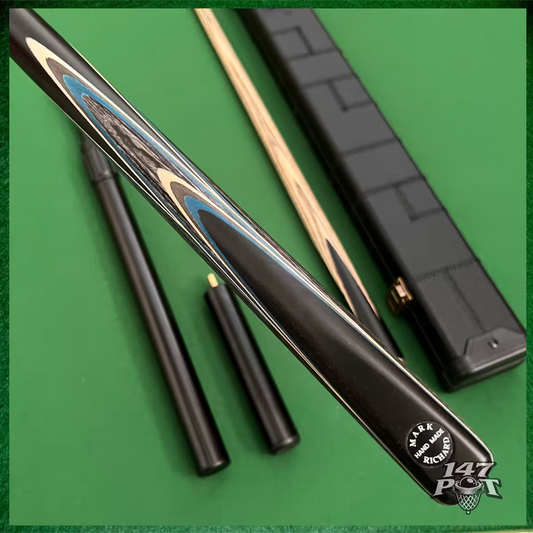
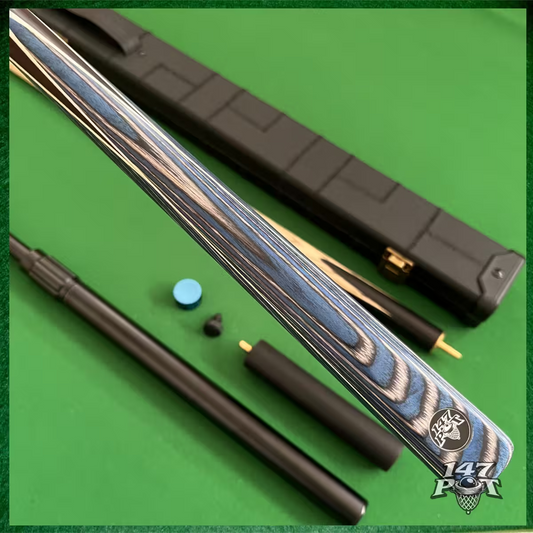
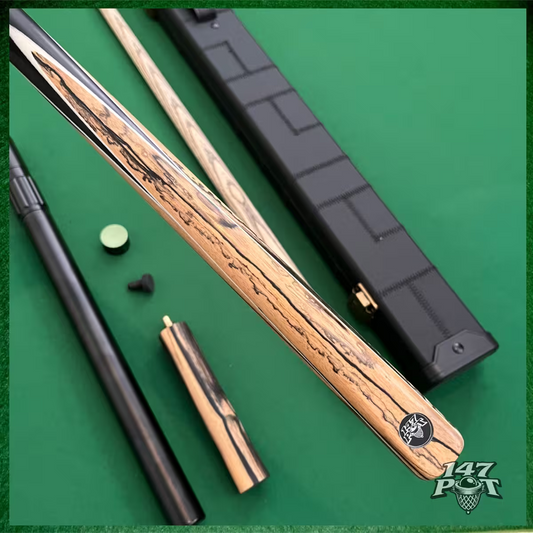
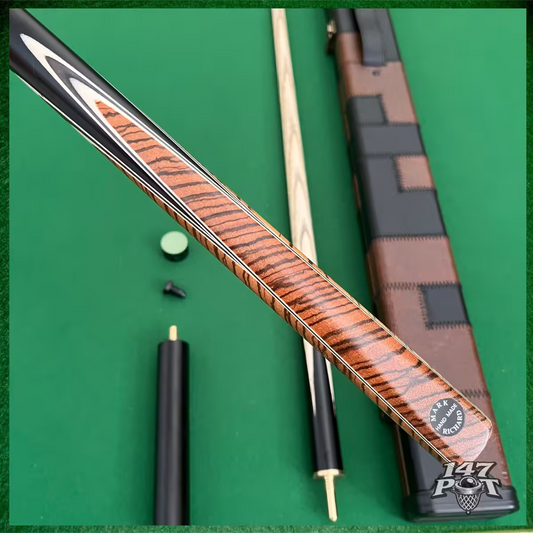
Explore 3/4 joint snooker cues, 147Pot handmade cues, Mark Richard cues and cue cases to compare suitable options. For complete packages, see the cue bundles.
⬆ Back to In This Guide
Sources are provided for the main technical and specification claims. Individual preferences and playing experiences will vary.
147Pot buying guide • Updated October 2026. Recommendations are practical guidance rather than guarantees of individual playing performance.